

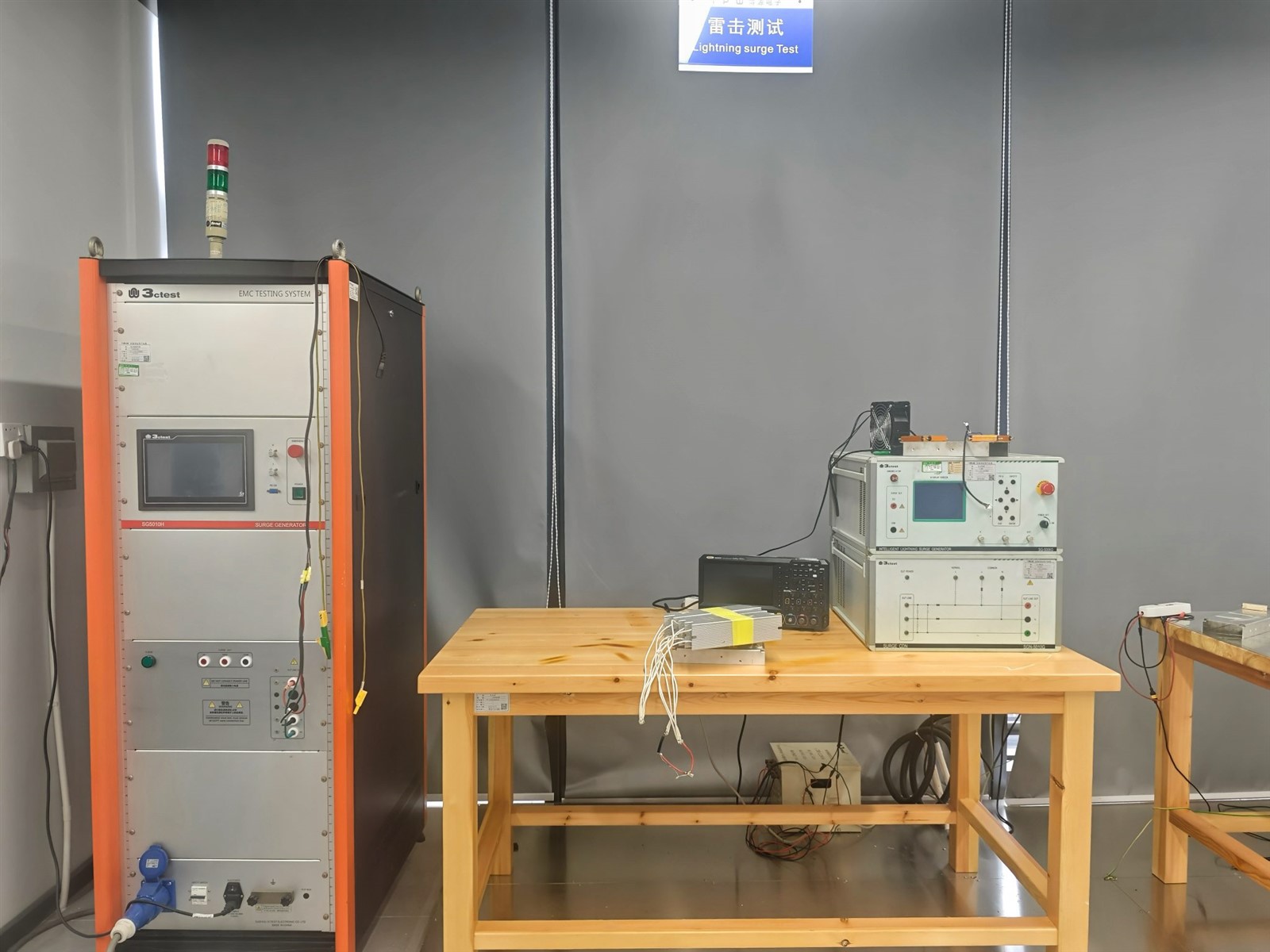
Surge, also known as a transient voltage, refers to a momentary overvoltage that exceeds the normal working voltage. Essentially, a surge is an intense pulse that occurs within just a few millionths of a second. Potential causes of surges include heavy equipment, short circuits, power switching, or large engines. Products equipped with surge suppression devices can effectively absorb sudden bursts of high energy, protecting connected equipment from damage.
Ⅱ,Characteristics of Surges
The duration of a surge is extremely short, typically on the microsecond scale. When a surge occurs, the amplitude of the voltage and current exceeds twice the normal value. Due to the rapid charging of the input filter capacitor, the peak current is far greater than the steady-state input current. Power supplies should limit the surge levels that AC switches, rectifier bridges, fuses, and EMI filter components can withstand. Repeated switching cycles should not damage the power supply or cause the fuse to blow under AC input voltage.
Ⅲ,Core Classification of Lightning Surge (Based on IEC 61000-4-5 International Standard)
The protection level of lightning surge is primarily defined by the open-circuit test voltage, which serves as a key indicator for measuring the ability of electronic equipment to withstand instantaneous high-voltage impacts. The specific levels and corresponding voltages are as follows:
|
Protection Level |
Open-Circuit Voltage (kV) |
Typical Application Scenarios |
|
Level 1 |
0.5 |
Low-risk environments (e.g., controlled laboratories, well-shielded indoor equipment) |
|
Level 2 |
1.0 |
Low-risk environments (e.g., controlled laboratories, well-shielded indoor equipment) |
|
Level 3 |
2.0 |
Semi-outdoor / complex indoor environments (e.g., commercial equipment, industrial control devices in non-exposed areas) |
|
Level 4 |
3.0 |
Outdoor / high-risk environments (e.g., outdoor communication equipment, industrial devices directly exposed to power grid fluctuations) |
|
Level X |
4.0 |
Special extreme scenarios (e.g., equipment near high-voltage substations, dedicated devices in thunderstorm-prone areas) |
IV. General Lightning Surge Requirements for Power Adapters
Based on industry standards (IEC 61000-4-5), the lightning surge protection requirements for power adapters vary across different scenarios:
Basic Indoor Scenarios (e.g., common household chargers, office equipment adapters): Typically require 1.0-2.5kV protection to address minor grid fluctuations or indirect lightning interference.
Scenarios with Primary Surge Protection (e.g., commercial electronic devices, network adapters): Require up to 6kV protection to withstand close-range indirect lightning strikes or strong grid disturbances.
Extreme Special Scenarios (e.g., outdoor base stations, equipment near high-voltage areas): Require customized protection of 10kV or higher, representing a niche high-cost demand beyond mainstream industry requirements.
V. Core Advantages of Topow Power Adapters: Surpassing Mainstream Standards with Full-Scenario High Protection
Shenzhen Topow Electronics Co.,Ltd specializes in the R&D and manufacturing of power adapters, adhering to stringent quality standards. All products undergo comprehensive reliability tests, including IEC/EN 61000-4-5 (surge immunity 4/6kV), withstand voltage, insulation, and thermal cycling, ensuring their safety and stability in various complex electrical environments.
- 4kV Protection: Effortlessly Handles Outdoor and Industrial High-Risk Environments
Compared with the 2.0-2.5kV protection limit of most products in the industry, our products' 4kV capability directly meets the needs of high-frequency high-risk scenarios such as outdoor equipment (e.g., outdoor displays, charging stations) and industrial control devices. This effectively mitigates indirect lightning strikes in most regions, significantly reducing failure rates due to surge damage.
- 6kV Protection: All-in-One Solution Replacing "Adapter + External Surge Protector" Setups
Mainstream 6kV protection often relies on a combination of "adapter + external surge protector (SPD)," which increases costs, complicates installation, and may reduce protection effectiveness due to compatibility issues. Our products feature built-in 6kV highly integrated protection circuits, eliminating the need for additional components. They are directly applicable in commercial server rooms, network communication equipment, and civilian devices in thunderstorm-prone areas, saving costs and enhancing system reliability.
- Broad Scenario Compatibility: From Industrial to Commercial, No Need for Multi-Specification Selection
Most manufacturers require separate models for 2.5kV (household), 4kV (industrial), and 6kV (commercial) protection, forcing customers to stock multiple specifications. Our products cover a 4kV-6kV protection range, with a single model meeting all scenarios from industrial outdoor to commercial high protection, simplifying supply chain management and reducing inventory pressure.
- Superior Stability: Balanced Design for High Protection and Low False Triggering
Some high-protection products face the issue of "higher protection voltage leading to false triggering under normal conditions," disrupting device operation. Utilizing dedicated surge detection chips and multi-level protection circuit design, our products achieve 4kV-6kV high protection while ensuring "zero misjudgment" of normal grid fluctuations, balancing protection performance and operational stability.


