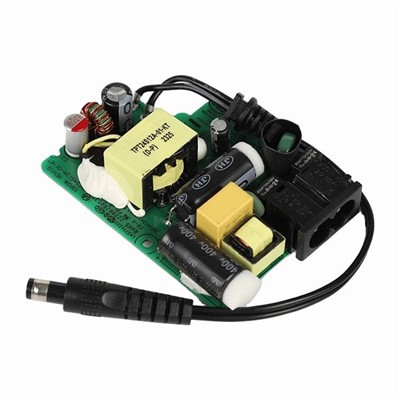

Hey there! As a supplier of single rail power supplies, I often get asked about the efficiency of these power supplies, especially at low loads. So, I thought I'd take a deep dive into this topic and share my thoughts and insights.
Let's start by understanding what single rail power supplies are. A single rail power supply is a type of power supply that provides a single output voltage. This is different from multi - rail power supplies, which offer multiple output voltages. Single rail power supplies are commonly used in a variety of applications, such as AC - DC Switching Power Supply, Medical Open - Frame Power Supply, and LED Driver Power Board.
Now, the big question: Are single rail power supplies more efficient at low loads? Well, to answer this, we need to look at how power supply efficiency works. Efficiency in a power supply is defined as the ratio of the output power to the input power. In an ideal world, we'd want this ratio to be 100%, but in reality, there are always losses due to factors like heat dissipation, component inefficiencies, and more.
At low loads, single rail power supplies have some advantages. One of the main reasons is simplicity. Since there's only one output rail, there are fewer components involved in regulating and distributing power. Fewer components mean less power consumption just to keep the power supply running. For example, multi - rail power supplies often have complex circuitry to balance the loads across different rails. This circuitry consumes power even when the load is low, reducing the overall efficiency.
Let's take a look at some technical aspects. In a single rail power supply, the voltage regulation is generally simpler. The voltage regulator doesn't have to deal with multiple output voltages and their associated load variations. This means that it can operate more efficiently at low loads. When the load is low, the power supply doesn't have to work as hard to maintain the output voltage, and there are fewer losses in the regulation process.
Another factor is the transformer design. Single rail power supplies usually have a simpler transformer design compared to multi - rail ones. A simpler transformer has lower core losses and fewer winding losses, which contribute to better efficiency at low loads. The transformer doesn't have to handle the complex task of providing multiple voltages simultaneously, so it can focus on providing a single, stable output voltage.


However, it's not all sunshine and rainbows. There are some cases where single rail power supplies might not be as efficient at low loads. For instance, if the single rail power supply is designed for a high - power application and is used at a very low load, it might not operate at its optimal efficiency. This is because the power supply has a certain minimum power consumption just to keep its internal components functioning. If the load is too low, this minimum power consumption becomes a significant percentage of the total input power, reducing the overall efficiency.
In addition, the type of load also matters. Some loads have specific power requirements and characteristics. For example, certain electronic devices might have a high inrush current when they're first turned on. A single rail power supply might struggle to handle this inrush current efficiently at low loads, especially if it's not designed to do so.
Let's talk about real - world applications. In many consumer electronics, like small LED lamps or low - power medical devices, single rail power supplies are a great choice at low loads. These devices typically have a relatively stable and low power demand. A single rail power supply can provide the necessary power efficiently without the added complexity and power consumption of a multi - rail design.
On the other hand, in industrial applications where there are multiple loads with different power requirements, multi - rail power supplies might still be preferred. Even though they might be less efficient at low loads in general, they can better handle the complex power distribution needs of these applications.
To sum it up, in most cases, single rail power supplies are more efficient at low loads. Their simplicity, fewer components, and simpler voltage regulation make them a great option for low - load applications. But it's important to choose the right power supply based on the specific requirements of the application.
If you're in the market for a single rail power supply, whether it's for an AC - DC Switching Power Supply, Medical Open - Frame Power Supply, or LED Driver Power Board, I'd be more than happy to help. We have a wide range of single rail power supplies that are designed to offer high efficiency, especially at low loads. Feel free to reach out to discuss your specific needs and see how we can provide the best solution for you.
References:
- "Power Supply Design Handbook" by Marty Brown
- "Switch - Mode Power Supplies: SPICE Simulations and Practical Designs" by Christophe Basso