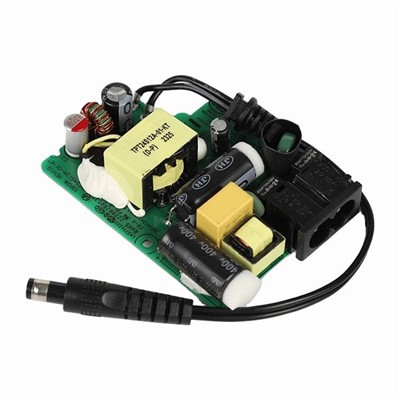

As a supplier of PCB mount power supplies, I've witnessed firsthand the challenges that come with inrush current. Inrush current is the initial high current that flows into a power supply when it's first turned on. This surge can be several times higher than the normal operating current, potentially causing damage to the power supply itself, other components on the PCB, and even the electrical system it's connected to. In this blog, I'll share some effective strategies to limit the inrush current of a PCB mount power supply.
Understanding Inrush Current
Before diving into the solutions, it's crucial to understand what causes inrush current. When a power supply is switched on, the capacitors in the input filter circuit act like short circuits. They quickly charge up to the input voltage, drawing a large amount of current in the process. This sudden surge can stress the components and lead to premature failure.


Another factor that contributes to inrush current is the transformer. When the power supply is energized, the transformer's core needs to be magnetized. This magnetization process requires a large amount of current, especially if the transformer has a high inductance.
Strategies to Limit Inrush Current
1. NTC Thermistors
One of the most common and cost - effective ways to limit inrush current is by using Negative Temperature Coefficient (NTC) thermistors. These thermistors have a high resistance at low temperatures and a low resistance at high temperatures.
When the power supply is first turned on, the NTC thermistor has a high resistance, which limits the inrush current. As the current flows through the thermistor, it heats up, and its resistance decreases. This allows the power supply to operate normally with a low - resistance path.
However, NTC thermistors have some limitations. They have a limited number of inrush events they can handle, and they dissipate power during normal operation, which can reduce the overall efficiency of the power supply.
2. Relay - Based Inrush Current Limiters
Relay - based inrush current limiters use a resistor in series with the power supply input to limit the inrush current when the power is first turned on. After a short delay, a relay bypasses the resistor, allowing the power supply to operate normally.
This method is more efficient than using NTC thermistors because the resistor is only in the circuit during the inrush period. However, relays have a limited lifespan, and they can be noisy and bulky.
3. Active Inrush Current Limiters
Active inrush current limiters use electronic components such as MOSFETs or IGBTs to control the inrush current. These limiters can sense the input voltage and current and adjust the switching of the power devices accordingly.
Active inrush current limiters offer several advantages. They can provide more precise control of the inrush current, and they can adapt to different input conditions. They also have a longer lifespan compared to relays and can operate more quietly. However, they are more expensive than NTC thermistors and relay - based limiters.
Selecting the Right Inrush Current Limiting Method
When choosing an inrush current limiting method for your PCB mount power supply, several factors need to be considered:
Cost
If cost is a major concern, NTC thermistors may be the best option. They are relatively inexpensive and easy to implement. However, if you need a more advanced and efficient solution, relay - based or active inrush current limiters may be worth the extra cost.
Efficiency
For applications where efficiency is crucial, active inrush current limiters are the best choice. They dissipate less power during normal operation compared to NTC thermistors and relay - based limiters.
Space Constraints
If space is limited on your PCB, NTC thermistors or active inrush current limiters may be more suitable. Relays can be bulky and may not fit in tight spaces.
Number of Inrush Events
If your power supply will be turned on and off frequently, a relay - based or active inrush current limiter may be more reliable than an NTC thermistor, which has a limited number of inrush events it can handle.
Our Product Offerings
At our company, we offer a wide range of PCB mount power supplies, including LED Driver Power Board, AC - DC Switching Power Supply, and 90W Single Output Open Frame Power Supply.
All our power supplies are designed with inrush current limiting in mind. We can customize the inrush current limiting method based on your specific requirements. Whether you need a cost - effective solution using NTC thermistors or a high - performance active inrush current limiter, we have the expertise to meet your needs.
Conclusion
Limiting the inrush current of a PCB mount power supply is essential for ensuring the reliability and longevity of the power supply and the entire electrical system. By understanding the causes of inrush current and the different strategies available, you can choose the most suitable method for your application.
If you are in the market for a PCB mount power supply and need help with inrush current limiting, we are here to assist you. Our team of experts can provide you with detailed technical advice and customized solutions. Contact us to start a discussion about your power supply needs and explore how we can help you optimize your system performance.
References
- Pressman, A. I. (2009). Switching Power Supply Design (3rd ed.). McGraw - Hill.
- Erickson, R. W., & Maksimovic, D. (2001). Fundamentals of Power Electronics (2nd ed.). Springer.
- National Semiconductor Corporation. (2002). Linear Technology Application Note 118: Inrush Current Limiting.