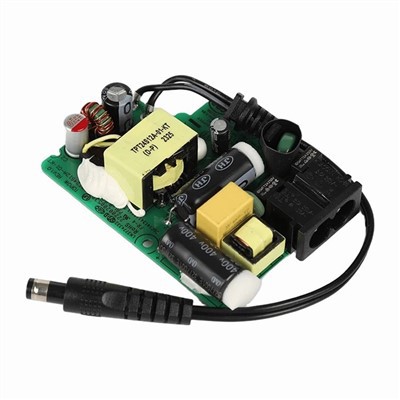

As a supplier of single rail power supplies, I've had the privilege of working closely with these essential components and understanding their intricacies. While single rail power supplies offer numerous advantages, it's crucial to shed light on their disadvantages to help our customers make informed decisions. In this blog post, I'll delve into the drawbacks of single rail power supplies, providing a comprehensive overview of their limitations.
Limited Voltage Flexibility
One of the primary disadvantages of single rail power supplies is their limited voltage flexibility. Unlike multi - rail power supplies, which can provide multiple output voltages simultaneously, single rail power supplies offer only one fixed output voltage. This can be a significant limitation in applications that require different voltage levels to power various components.
For instance, in a complex electronic system such as a computer motherboard, different components like the CPU, GPU, and memory modules may require different voltages to operate optimally. A single rail power supply would be unable to directly provide these varying voltages, necessitating the use of additional voltage regulators or converters. These additional components not only add to the cost and complexity of the system but also increase the power consumption and heat generation.
Overloading Risks
Single rail power supplies are more prone to overloading compared to multi - rail power supplies. Since all the power is delivered through a single rail, any excessive current draw from a single component can quickly push the power supply beyond its rated capacity. This can lead to a variety of issues, including overheating, component failure, and even system shutdown.
In a multi - rail power supply, the current is distributed across multiple rails, which helps to prevent overloading on any single rail. If one component tries to draw too much current, the other rails can continue to supply power to the remaining components, reducing the risk of a complete system failure. In contrast, a single rail power supply has no such built - in protection mechanism, making it more vulnerable to overloading scenarios.
Poor Transient Response
Transient response refers to the ability of a power supply to quickly adjust its output voltage in response to sudden changes in the load current. Single rail power supplies often have a relatively poor transient response compared to multi - rail power supplies.
When there is a sudden increase in the load current, a single rail power supply may not be able to adjust its output voltage fast enough. This can result in a temporary drop in the output voltage, which can cause instability in the connected electronic components. In some cases, this voltage drop can be significant enough to cause the components to malfunction or even be damaged.
EMI and RFI Issues
Electromagnetic interference (EMI) and radio - frequency interference (RFI) are common problems in power supplies. Single rail power supplies are more likely to generate higher levels of EMI and RFI compared to multi - rail power supplies.
The high - current flow through a single rail can create strong electromagnetic fields, which can interfere with the operation of other electronic devices in the vicinity. This interference can manifest as noise in audio or video signals, data errors in communication systems, or even complete system failures. To mitigate these issues, additional shielding and filtering components are often required, which again add to the cost and size of the power supply.
Lack of Redundancy
Redundancy is an important feature in many critical applications, such as data centers and medical equipment. Single rail power supplies do not offer any redundancy. If the single rail fails, the entire power supply will stop working, leading to a complete shutdown of the connected system.
In contrast, multi - rail power supplies can be designed with redundant rails. In the event of a failure in one rail, the other rails can continue to supply power, ensuring the continuous operation of the system. This redundancy feature is crucial in applications where downtime can have serious consequences, such as in life - saving medical devices or data - critical servers.
Applications and Mitigation Strategies
Despite these disadvantages, single rail power supplies still have their place in many applications. They are often used in simple electronic devices where the power requirements are relatively low and the need for multiple voltage levels is minimal. For example, in small consumer electronics like LED lights, chargers, and some low - power sensors, single rail power supplies can provide a cost - effective and reliable solution.
To mitigate the disadvantages of single rail power supplies, several strategies can be employed. For the issue of limited voltage flexibility, external voltage regulators can be used to convert the single output voltage to the required levels. To reduce the risk of overloading, proper load management and sizing of the power supply are essential. This involves accurately calculating the power requirements of all the connected components and selecting a power supply with an appropriate capacity.
For improving the transient response, larger output capacitors can be used in the power supply design. These capacitors can store energy and release it quickly when there is a sudden increase in the load current, helping to maintain a stable output voltage. To address the EMI and RFI issues, proper shielding and filtering techniques can be applied during the manufacturing process.
Our Product Offerings
At our company, we offer a range of single rail power supplies that are designed to meet the specific needs of our customers. Our PCB Mount Power Supply is a compact and reliable solution for applications where space is limited. It provides a stable single output voltage and is easy to integrate into printed circuit boards.


Our 12V3A Bare Board is another popular product. It offers a simple and cost - effective way to power low - power electronic devices. With its high efficiency and compact design, it is suitable for a wide range of applications.
For more demanding applications, our 90W Single Output Open Frame Power Supply provides a higher power output while still maintaining a relatively small form factor. It is designed to meet the strictest quality and safety standards.
Conclusion
In conclusion, while single rail power supplies have their limitations, they also offer several advantages such as simplicity and cost - effectiveness. By understanding the disadvantages of single rail power supplies, our customers can make more informed decisions when selecting the appropriate power supply for their applications.
If you are interested in learning more about our single rail power supplies or have specific requirements for your project, we encourage you to contact us for a detailed discussion. Our team of experts is ready to assist you in finding the best power supply solution for your needs.
References
- "Power Supply Design Handbook" by Marty Brown
- "Electromagnetic Compatibility Engineering" by Henry W. Ott
- Technical papers from leading power supply manufacturers