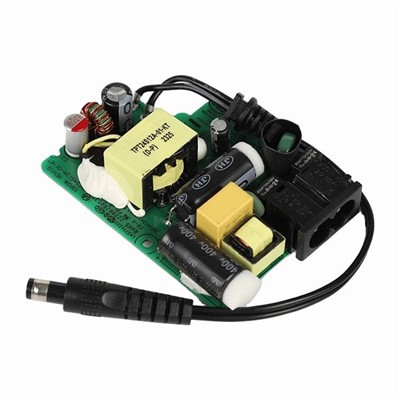

In the realm of AC - DC switching power supplies, capacitors play a pivotal role. As a seasoned AC - DC Switching Power Supply supplier, I've witnessed firsthand how the right choice of capacitors can significantly impact the performance, reliability, and efficiency of power supplies. In this blog, I'll delve into the key requirements for capacitors in an AC - DC switching power supply.
Capacitance Value
The capacitance value is one of the most fundamental requirements. It determines the capacitor's ability to store electrical charge. In an AC - DC switching power supply, different stages have different capacitance needs.
In the input stage, a large - value capacitor is often required. This capacitor is used to smooth out the rectified AC voltage, reducing the ripple voltage. A higher capacitance value can store more charge, which helps to maintain a relatively stable DC voltage even when the input voltage fluctuates. For example, in a power supply designed for a wide input voltage range (e.g., 90 - 264VAC), a capacitor with a capacitance in the range of several microfarads to hundreds of microfarads might be used.
In the output stage, the capacitance value also needs to be carefully selected. The output capacitor is responsible for filtering the high - frequency noise and providing a stable DC output voltage to the load. The required capacitance depends on the load current and the allowable ripple voltage. For a low - power LED Driver Power Board, a smaller capacitance value might be sufficient, while for a high - power PCB Mount Power Supply, a larger capacitance is usually needed. You can find more information about these products on our website: LED Driver Power Board and PCB Mount Power Supply.
Voltage Rating
The voltage rating of a capacitor is another crucial requirement. It must be able to withstand the maximum voltage that will be applied across it in the power supply circuit. In the input stage of an AC - DC switching power supply, the capacitor is exposed to the rectified AC voltage. The peak value of the rectified voltage can be quite high, especially when the input voltage is at its maximum. Therefore, the voltage rating of the input capacitor should be selected to ensure that it can handle this peak voltage without breaking down.
For example, in a power supply with an input voltage range of 90 - 264VAC, the peak value of the rectified voltage can reach around 370V. So, a capacitor with a voltage rating of at least 400V or higher is typically used. In the output stage, the voltage rating of the capacitor should be chosen based on the output voltage of the power supply, with a certain safety margin. For a 12V3A Bare Board, a capacitor with a voltage rating of 16V or 25V might be appropriate.
ESR (Equivalent Series Resistance)
ESR is an important parameter that describes the internal resistance of a capacitor. In an AC - DC switching power supply, a low ESR capacitor is generally preferred. A low ESR helps to reduce power losses and heat generation in the capacitor.
When a capacitor is used to filter high - frequency signals, a high ESR can cause significant voltage drops across the capacitor, leading to increased ripple voltage and reduced efficiency. In the output stage of a power supply, a low - ESR capacitor can improve the transient response of the power supply, allowing it to quickly adapt to changes in the load current.
For high - frequency switching power supplies, ceramic capacitors are often used because they typically have a very low ESR. However, for applications that require a large capacitance value, electrolytic capacitors might be used, and efforts should be made to select those with a relatively low ESR.
Temperature Stability
The performance of a capacitor can be greatly affected by temperature. In an AC - DC switching power supply, the internal temperature can rise due to power losses in various components, including the capacitors themselves. Therefore, the capacitor should have good temperature stability.
Capacitors with a wide operating temperature range are preferred. For example, some capacitors are designed to operate in a temperature range of - 40°C to + 105°C. This ensures that the capacitor can maintain its electrical characteristics within the expected temperature variations in the power supply. A capacitor with poor temperature stability may experience changes in capacitance value, ESR, and leakage current as the temperature changes, which can degrade the performance of the power supply.
Ripple Current Rating
The ripple current rating of a capacitor is the maximum amount of alternating current that the capacitor can handle without overheating. In an AC - DC switching power supply, there is always a certain amount of ripple current flowing through the capacitors, especially in the input and output stages.
If the ripple current exceeds the rating of the capacitor, it can cause excessive heat generation, which may lead to a shortened lifespan of the capacitor or even its failure. Therefore, it is essential to select a capacitor with a sufficient ripple current rating. The ripple current rating depends on factors such as the switching frequency of the power supply, the load current, and the capacitance value of the capacitor.
Leakage Current
Leakage current is the small amount of current that flows through a capacitor even when it is supposed to be blocking the flow of direct current. In an AC - DC switching power supply, a low leakage current is desirable.
High leakage current can cause power losses and may also affect the accuracy of the power supply output voltage. It can also lead to safety issues in some applications. For example, in a power supply for medical equipment, a low leakage current is a critical requirement to ensure the safety of the patients. Capacitors with good insulation materials and proper manufacturing processes are selected to minimize the leakage current.
Frequency Response
The frequency response of a capacitor is important, especially in high - frequency AC - DC switching power supplies. Capacitors have different impedance characteristics at different frequencies.
In the input stage, the capacitor needs to be able to filter out the high - frequency noise generated by the rectifier and the switching circuit. A capacitor with a good high - frequency response can effectively suppress these noise signals. In the output stage, the capacitor should also be able to handle the high - frequency components of the load current and provide a stable DC output.
Physical Size and Mounting
The physical size and mounting method of the capacitor are also important considerations. In modern AC - DC switching power supplies, there is a trend towards miniaturization. Therefore, capacitors with a small form factor are often preferred.


The mounting method should be compatible with the PCB layout of the power supply. Surface - mount capacitors are widely used in today's power supplies because they are suitable for automated assembly processes and can save space on the PCB. Through - hole capacitors, on the other hand, may be used in some applications where higher power handling or better mechanical stability is required.
Conclusion
Selecting the right capacitors for an AC - DC switching power supply is a complex task that requires careful consideration of multiple factors, including capacitance value, voltage rating, ESR, temperature stability, ripple current rating, leakage current, frequency response, and physical size. As an AC - DC Switching Power Supply supplier, we understand the importance of these requirements and are committed to providing high - quality power supplies that meet the diverse needs of our customers.
If you are in the market for AC - DC switching power supplies or have any questions about capacitor selection, we invite you to contact us for a detailed discussion. Our team of experts is ready to assist you in finding the most suitable solutions for your specific applications.
References
- "Power Electronics: Converters, Applications, and Design" by Ned Mohan, Tore M. Undeland, and William P. Robbins
- "Switch - Mode Power Supplies: SPICE Simulations and Practical Designs" by Christophe Basso