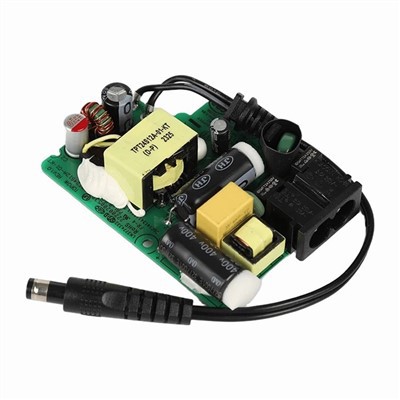

As a supplier of PCB Mount Power Supplies, I often encounter inquiries about the hold - up time of these power supplies. Hold - up time is a crucial parameter in the performance of a PCB mount power supply, and understanding it is essential for both designers and end - users.
What is Hold - up Time?
Hold - up time refers to the duration that a power supply can continue to provide regulated output power after the input power is interrupted. In other words, it is the time during which the power supply can "hold up" the output voltage within an acceptable range when the main power source fails. This is particularly important in applications where a sudden loss of power could lead to data loss, system malfunctions, or even safety hazards.
For example, in industrial control systems, a brief power interruption could cause a machine to stop in an improper state, leading to production delays or equipment damage. In data centers, a power glitch might result in data corruption or server crashes. In these scenarios, a power supply with an adequate hold - up time can bridge the gap until backup power sources, such as uninterruptible power supplies (UPS), kick in.
Factors Affecting Hold - up Time
Several factors influence the hold - up time of a PCB mount power supply. The most significant one is the energy storage capacity of the power supply. This is typically determined by the capacitance of the input electrolytic capacitors. Capacitors store electrical energy in an electric field, and when the input power is lost, they release this energy to maintain the output voltage. A larger capacitance generally means a longer hold - up time.
The output power of the power supply also plays a crucial role. Higher output power requires more energy to be maintained during the hold - up period. So, for a given capacitance, a power supply with a higher output power will have a shorter hold - up time compared to one with a lower output power.
The efficiency of the power supply is another factor. A more efficient power supply converts a higher percentage of the input energy into output power. During the hold - up time, when the energy is drawn from the capacitors, a more efficient power supply can make better use of the stored energy, resulting in a longer hold - up time.
Calculating Hold - up Time
The hold - up time can be calculated using the following simplified formula:
[t_{hold}=\frac{C\times(V_{in}^2 - V_{min}^2)}{2\times P_{out}}]
where (t_{hold}) is the hold - up time in seconds, (C) is the capacitance of the input capacitor in farads, (V_{in}) is the nominal input voltage, (V_{min}) is the minimum input voltage required to maintain the regulated output, and (P_{out}) is the output power in watts.
For example, if we have a PCB mount power supply with an input capacitor of (1000\ \mu F), a nominal input voltage of (230\ V), a minimum input voltage of (180\ V), and an output power of (30\ W), we can calculate the hold - up time as follows:
First, convert the capacitance to farads: (C = 1000\times10^{- 6}\ F=0.001\ F)
[t_{hold}=\frac{0.001\times(230^2 - 180^2)}{2\times30}]
[t_{hold}=\frac{0.001\times(52900 - 32400)}{60}]


[t_{hold}=\frac{0.001\times20500}{60}]
[t_{hold}=\frac{20.5}{60}\approx0.34\ s]
Importance in Different Applications
Industrial Applications
In industrial automation, PCB mount power supplies are used to power various control systems, sensors, and actuators. A sudden power loss can disrupt the production process, leading to significant financial losses. A power supply with a sufficient hold - up time can ensure that the control systems have enough time to perform a safe shutdown or wait for the backup power to start. For example, in a conveyor belt system, the power supply needs to maintain the output for a few seconds to allow the belt to stop smoothly, preventing product damage.
LED Lighting Applications
In LED lighting, especially in large - scale lighting installations such as stadiums or commercial buildings, a power interruption can cause a sudden blackout, which is not only inconvenient but also potentially dangerous. A PCB mount power supply with an appropriate hold - up time can keep the LEDs lit for a short period, providing a smooth transition to backup lighting or allowing for a proper shutdown. Our LED Driver Power Board is designed to meet the hold - up time requirements of such applications.
Telecommunications
Telecommunication equipment requires a stable power supply to ensure continuous communication. A short power outage can disrupt phone calls, data transmission, and network connectivity. PCB mount power supplies with long hold - up times are used in routers, switches, and base stations to prevent service interruptions during power fluctuations.
Our PCB Mount Power Supplies and Hold - up Time
At our company, we understand the importance of hold - up time in different applications. That's why we design and manufacture our PCB Mount Power Supply with careful consideration of this parameter. Our products are equipped with high - quality input capacitors to ensure an adequate energy storage capacity.
We offer a wide range of power supplies with different output powers and hold - up time options. For example, our 12V3A Bare Board is designed to provide a reliable power source with a reasonable hold - up time for various low - power applications.
Conclusion
Hold - up time is a critical characteristic of PCB mount power supplies. It ensures the reliability and stability of electrical systems in the face of power interruptions. By understanding the factors that affect hold - up time and carefully selecting the appropriate power supply, designers can meet the specific requirements of their applications.
If you are in the market for a PCB mount power supply and need a product with a specific hold - up time, we are here to help. Our team of experts can assist you in choosing the right power supply for your needs. Feel free to contact us for more information and to start a procurement discussion.
References
- "Power Supply Design Handbook", by Marty Brown
- "Electronic Circuits: Fundamentals and Applications", by Tony R. Kuphaldt