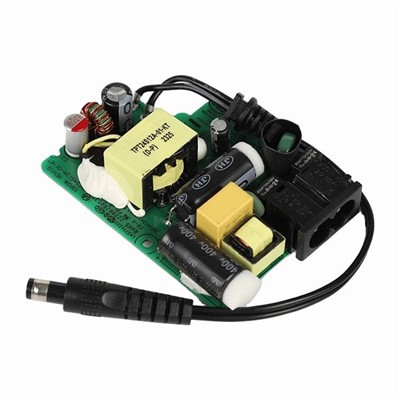

When it comes to designing an AC - DC switching power supply, one of the most critical decisions is the selection of the Metal - Oxide - Semiconductor Field - Effect Transistor (MOSFET). As a well - established AC - DC Switching Power Supply supplier, I've witnessed firsthand how the right MOSFET can significantly enhance the performance, efficiency, and reliability of power supplies. In this blog, I'll share insights into the key factors to consider when choosing a MOSFET for an AC - DC switching power supply.
Understanding the Role of MOSFETs in AC - DC Switching Power Supplies
MOSFETs play a pivotal role in AC - DC switching power supplies. They act as electronic switches, controlling the flow of current through the power supply circuit. By rapidly turning on and off, MOSFETs convert the incoming AC voltage into a high - frequency DC voltage, which can then be regulated and stepped down to the desired output voltage. This switching action is what allows AC - DC switching power supplies to be more efficient and compact compared to traditional linear power supplies.


Key Parameters for MOSFET Selection
1. Voltage Rating (Vds)
The drain - to - source voltage rating (Vds) of a MOSFET is one of the most important parameters. It must be high enough to withstand the maximum voltage that will be applied across the MOSFET during normal operation. In an AC - DC switching power supply, the input voltage can vary, and there may also be voltage spikes due to switching transients. As a general rule, it's advisable to select a MOSFET with a Vds rating that is at least 20 - 30% higher than the maximum expected voltage in the circuit. For example, if the maximum input voltage in your power supply is 400V, a MOSFET with a Vds rating of 500V or higher would be a suitable choice.
2. Current Rating (Id)
The continuous drain current rating (Id) indicates the maximum amount of current that the MOSFET can handle without overheating. In an AC - DC switching power supply, the current flowing through the MOSFET depends on the load requirements and the power conversion efficiency. It's crucial to select a MOSFET with an Id rating that can comfortably handle the maximum current in the circuit. Additionally, consider the pulse current rating (Idm) for short - duration high - current pulses that may occur during startup or under transient load conditions.
3. On - Resistance (Rds(on))
The on - resistance (Rds(on)) of a MOSFET is the resistance between the drain and source when the MOSFET is fully turned on. A lower Rds(on) results in less power dissipation in the MOSFET, which improves the overall efficiency of the power supply. In high - power applications, even a small reduction in Rds(on) can lead to significant savings in power consumption and heat generation. When selecting a MOSFET, look for devices with the lowest possible Rds(on) within your budget and voltage/current requirements.
4. Gate - to - Source Threshold Voltage (Vgs(th))
The gate - to - source threshold voltage (Vgs(th)) is the minimum voltage required at the gate to turn on the MOSFET. It's important to choose a MOSFET with a Vgs(th) that is compatible with the gate driver circuit in your power supply. If the Vgs(th) is too high, the gate driver may not be able to provide enough voltage to fully turn on the MOSFET, resulting in increased power dissipation and reduced efficiency. On the other hand, if the Vgs(th) is too low, the MOSFET may turn on accidentally due to noise or voltage fluctuations.
5. Switching Speed
The switching speed of a MOSFET is determined by its rise time (tr) and fall time (tf). A fast - switching MOSFET can reduce the switching losses in the power supply, especially at high frequencies. In AC - DC switching power supplies, which often operate at frequencies in the range of tens to hundreds of kilohertz, a MOSFET with a short rise and fall time can improve the overall efficiency and reduce electromagnetic interference (EMI). However, faster - switching MOSFETs may also be more expensive and require more careful circuit design to minimize ringing and voltage overshoot.
Application - Specific Considerations
1. Power Level
The power level of the AC - DC switching power supply is a major factor in MOSFET selection. For low - power applications (less than 100W), a small - signal MOSFET with a relatively low current and voltage rating may be sufficient. These MOSFETs are often more cost - effective and have lower power dissipation. In high - power applications (above 100W), such as industrial power supplies or server power supplies, larger - package MOSFETs with higher current and voltage ratings are required. These MOSFETs may also need additional heat sinking to dissipate the heat generated during operation.
2. Switching Frequency
The switching frequency of the power supply affects the choice of MOSFET. Higher switching frequencies allow for smaller passive components, such as inductors and capacitors, which can reduce the size and cost of the power supply. However, higher frequencies also increase the switching losses in the MOSFET. For low - frequency applications (less than 50kHz), MOSFETs with a relatively slow switching speed may be acceptable. For high - frequency applications (above 100kHz), fast - switching MOSFETs are necessary to minimize switching losses and improve efficiency.
3. Thermal Management
Proper thermal management is essential for the reliable operation of MOSFETs in AC - DC switching power supplies. MOSFETs generate heat during operation, and if this heat is not dissipated effectively, it can lead to increased junction temperature, reduced performance, and even device failure. When selecting a MOSFET, consider its thermal resistance (Rθjc) and the maximum junction temperature (Tjmax). Additionally, choose a package that is suitable for heat sinking, such as a TO - 220 or D2PAK package.
Our Product Offerings
As an AC - DC Switching Power Supply supplier, we offer a wide range of AC - DC Switching Power Supply products that are designed to meet various application requirements. Our power supplies are built with high - quality MOSFETs and other components to ensure reliable and efficient operation.
We also provide Regulated Switching Power Module and PCB Mount Power Supply options, which are ideal for applications where space is limited or a more compact design is required. These products are carefully engineered to provide stable output voltage and high power density.
Conclusion
Selecting the right MOSFET for an AC - DC switching power supply is a complex process that requires careful consideration of multiple parameters and application - specific requirements. By understanding the key factors such as voltage rating, current rating, on - resistance, switching speed, and thermal management, you can make an informed decision and choose a MOSFET that will optimize the performance and efficiency of your power supply.
If you're in the market for high - quality AC - DC switching power supplies or need assistance with MOSFET selection for your power supply design, we're here to help. Our team of experts has extensive experience in power supply design and can provide you with the guidance and support you need. Contact us today to start a discussion about your specific requirements and explore how our products can meet your needs.
References
- Mohan, N., Undeland, T. M., & Robbins, W. P. (2012). Power Electronics: Converters, Applications, and Design. Wiley.
- Erickson, R. W., & Maksimović, D. (2001). Fundamentals of Power Electronics. Springer.
- Texas Instruments. (2019). MOSFET Selection Guide. Texas Instruments Application Report.