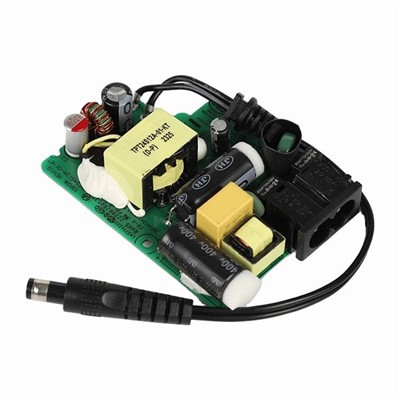

A single rail power supply is a crucial component in various electronic devices, providing a stable and consistent electrical current. One of the key performance indicators of a power supply is its noise level. In this blog post, we'll delve into what the noise level of a single rail power supply is, why it matters, and how our products as a single rail power supply supplier are designed to meet high - standard noise requirements.
Understanding Noise in a Single Rail Power Supply
Electrical noise in a single rail power supply refers to unwanted electrical signals that are superimposed on the desired DC output voltage. These unwanted signals can take various forms, such as ripple, spikes, and random fluctuations. Ripple is a periodic variation in the DC output voltage, often caused by the switching action in a switching power supply or the imperfect filtering of the rectified AC input. Spikes are short - duration, high - amplitude voltage transients that can occur due to sudden changes in the load or internal switching events. Random fluctuations, on the other hand, are less predictable and can be caused by factors like electromagnetic interference (EMI) from external sources or internal component noise.
The noise level is typically measured in millivolts peak - to - peak (mVp - p) or microvolts root - mean - square (μVrms). A lower noise level indicates a cleaner and more stable power output, which is essential for the proper functioning of sensitive electronic components.
Why Noise Level Matters
- Component Reliability: High noise levels can cause premature failure of electronic components. For example, excessive ripple voltage can stress capacitors, reducing their lifespan. Spikes and random fluctuations can also trigger false operations in integrated circuits, leading to system malfunctions.
- Signal Integrity: In applications where accurate signal processing is required, such as audio and video equipment, a high noise level can introduce artifacts and distortion. For instance, in an audio amplifier, power supply noise can be heard as a humming or buzzing sound in the output.
- System Performance: In precision measurement instruments and data acquisition systems, noise in the power supply can degrade the accuracy of measurements. Even a small amount of noise can introduce errors in the data, leading to inaccurate results.
Factors Affecting the Noise Level of a Single Rail Power Supply
- Switching Frequency: In switching power supplies, the switching frequency plays a significant role in determining the noise level. Higher switching frequencies generally result in lower ripple voltage because the output filter can be more effective at filtering out the high - frequency components. However, higher frequencies can also generate more EMI, which needs to be properly managed.
- Filtering Components: The quality and design of the output filter are crucial for reducing noise. Capacitors and inductors are commonly used in the filter circuit to smooth out the output voltage. High - quality capacitors with low equivalent series resistance (ESR) can effectively reduce ripple voltage.
- Load Conditions: The noise level can vary depending on the load connected to the power supply. A heavy load can cause more significant voltage drops and fluctuations, increasing the noise level. Additionally, sudden changes in the load can generate spikes and transients.
- PCB Layout: The layout of the printed circuit board (PCB) can also affect the noise level. Proper grounding, component placement, and trace routing can minimize EMI and crosstalk, reducing the overall noise in the power supply.
Our Single Rail Power Supply Products and Noise Level Management
As a single rail power supply supplier, we understand the importance of low noise levels in our products. Our engineers have implemented several design strategies to ensure that our power supplies meet the highest standards of noise performance.
- Advanced Filtering Design: We use high - quality filtering components in our power supplies to minimize ripple and noise. Our output filters are carefully designed to provide optimal performance across a wide range of load conditions. For example, in our 12V3A Bare Board, we have incorporated multiple stages of filtering to achieve a very low noise level.
- Optimized Switching Frequency: We carefully select the switching frequency of our switching power supplies to balance between low ripple voltage and EMI reduction. Our AC - DC Switching Power Supply uses an optimized switching frequency to ensure a clean and stable power output.
- High - Quality Components: We source only the highest - quality components for our power supplies. This includes using low - ESR capacitors and high - performance inductors, which contribute to lower noise levels. Our PCB Mount Power Supply is built with top - notch components to provide reliable and low - noise operation.
- Rigorous Testing: Every power supply we produce undergoes rigorous testing to ensure that it meets our strict noise level specifications. We use advanced testing equipment to measure the noise level under various load conditions and environmental factors.
Measuring the Noise Level of Our Single Rail Power Supplies
We use state - of - the - art test equipment to measure the noise level of our power supplies accurately. To measure the ripple voltage, we typically use an oscilloscope to capture the peak - to - peak value of the periodic variation in the DC output voltage. For measuring the random noise, we use a spectrum analyzer to analyze the frequency components of the noise.
Our test procedures are designed to simulate real - world operating conditions as closely as possible. We test our power supplies at different load levels, input voltages, and temperatures to ensure that they maintain a low noise level under all circumstances.
Applications of Our Low - Noise Single Rail Power Supplies
Our low - noise single rail power supplies are suitable for a wide range of applications, including:
- Audio and Video Equipment: The clean power output of our power supplies ensures that audio and video signals are not corrupted by noise, resulting in high - quality sound and image reproduction.
- Medical Devices: In medical equipment, where precision and reliability are of utmost importance, our low - noise power supplies provide a stable power source for sensitive components, ensuring accurate measurements and proper operation.
- Industrial Automation: In industrial control systems, our power supplies can help prevent false operations and system failures caused by power supply noise, improving the overall efficiency and reliability of the automation process.
Contact Us for Your Single Rail Power Supply Needs
If you are in the market for a high - quality single rail power supply with a low noise level, we would be delighted to assist you. Our team of experts can help you select the right power supply for your specific application and provide you with detailed technical information. Whether you need a 12V3A Bare Board, an AC - DC Switching Power Supply, or a PCB Mount Power Supply, we have the products and expertise to meet your requirements.


Feel free to reach out to us to start a discussion about your power supply needs. We look forward to working with you to provide the best single rail power supply solutions.
References
- "Power Supply Design Handbook", by Marty Brown.
- "Electromagnetic Compatibility Engineering", by Henry W. Ott.
- Technical documents from various component manufacturers on power supply design and noise reduction.