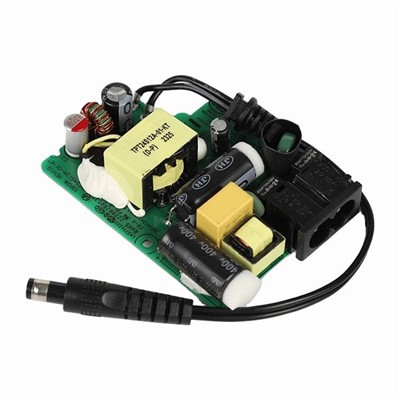

In the realm of electronics, power supplies play a pivotal role in ensuring the smooth operation of various devices. Among the different types of power supplies, PCB mount power supplies are widely used due to their compact size and ease of integration into printed circuit boards. However, the question of when an unregulated PCB mount power supply is suitable is a crucial one for both designers and manufacturers. As a supplier of PCB mount power supplies, I will delve into this topic to provide valuable insights.
Understanding Unregulated PCB Mount Power Supplies
Before discussing their suitability, it's essential to understand what unregulated PCB mount power supplies are. Unlike regulated power supplies that maintain a constant output voltage regardless of changes in input voltage or load, unregulated power supplies have an output voltage that varies with input voltage and load. They typically consist of a transformer, rectifier, and filter capacitor. The transformer steps down the input AC voltage, the rectifier converts it to DC, and the filter capacitor smooths out the DC voltage.
The main advantage of unregulated power supplies is their simplicity and low cost. They have fewer components compared to regulated power supplies, which reduces manufacturing costs and makes them more affordable. Additionally, their efficiency can be relatively high, especially at light loads. However, their output voltage can fluctuate, which may not be suitable for all applications.
Suitable Applications for Unregulated PCB Mount Power Supplies
Simple Electronic Devices
Unregulated PCB mount power supplies are well-suited for simple electronic devices that can tolerate some variation in the power supply voltage. For example, many consumer electronics such as remote controls, small toys, and simple LED indicators do not require a precise and stable power supply. These devices can function properly within a certain range of input voltages, and an unregulated power supply can provide the necessary power without the need for complex voltage regulation.
Battery Charging
In some battery charging applications, unregulated power supplies can be used. For instance, when charging simple lead-acid batteries, a constant voltage charging method can be employed. An unregulated power supply can provide a relatively stable voltage that is suitable for this type of charging. However, it's important to note that for more advanced battery chemistries such as lithium-ion batteries, regulated power supplies are usually required to ensure safe and efficient charging.
Low-Power and Cost-Sensitive Applications
In applications where power consumption is low and cost is a major consideration, unregulated PCB mount power supplies are an attractive option. For example, in some sensor nodes used in Internet of Things (IoT) applications, the power requirements are minimal, and the devices can operate with a less precise power supply. Using an unregulated power supply can significantly reduce the overall cost of the system without sacrificing its functionality.
When Unregulated PCB Mount Power Supplies Are Not Suitable
Precision Electronic Devices
Precision electronic devices such as medical equipment, high-end audio systems, and precision measurement instruments require a stable and accurate power supply. These devices are highly sensitive to voltage fluctuations, and even a small variation in the power supply voltage can affect their performance and accuracy. For example, in Medical Open-Frame Power Supply, the power supply needs to provide a constant voltage to ensure the proper operation of the medical device and the safety of the patient. In such cases, regulated power supplies are necessary.
Digital Circuits
Digital circuits, especially those operating at high speeds, require a stable power supply to function correctly. Voltage fluctuations can cause signal integrity issues, leading to errors in data transmission and processing. For example, in microcontrollers and digital signal processors, a stable power supply is essential to ensure reliable operation. Therefore, unregulated power supplies are generally not suitable for these applications.


Applications with High Load Variations
If an application experiences significant load variations, an unregulated power supply may not be able to provide a stable output voltage. As the load changes, the output voltage of an unregulated power supply can fluctuate, which can affect the performance of the connected devices. In contrast, regulated power supplies can adjust their output voltage to compensate for load variations and maintain a constant voltage.
Factors to Consider When Choosing an Unregulated PCB Mount Power Supply
Input Voltage Range
The input voltage range of the power supply is an important factor to consider. Different applications may have different input voltage requirements, and the power supply should be able to operate within the specified input voltage range. It's also important to ensure that the power supply can handle any voltage fluctuations within this range without affecting its performance.
Output Voltage and Current Requirements
The output voltage and current requirements of the application determine the specifications of the power supply. The power supply should be able to provide the required output voltage and current to ensure the proper operation of the connected devices. It's also important to consider the maximum output current that the power supply can handle to avoid overloading and damage to the power supply.
Efficiency
Efficiency is an important consideration, especially in applications where power consumption is a concern. A more efficient power supply can reduce energy consumption and heat generation, which can improve the reliability and lifespan of the power supply and the connected devices. When choosing an unregulated PCB mount power supply, it's important to compare the efficiency of different models to select the most suitable one.
Size and Mounting Requirements
The size and mounting requirements of the power supply are also important factors to consider. The power supply should be small enough to fit into the available space on the PCB and should be easy to mount. Different applications may have different mounting requirements, such as through-hole or surface-mount mounting, and the power supply should be compatible with these requirements.
Conclusion
In conclusion, unregulated PCB mount power supplies are suitable for certain applications where simplicity, low cost, and tolerance to voltage fluctuations are important. They are well-suited for simple electronic devices, battery charging, and low-power and cost-sensitive applications. However, they are not suitable for precision electronic devices, digital circuits, and applications with high load variations. When choosing an unregulated PCB mount power supply, it's important to consider factors such as input voltage range, output voltage and current requirements, efficiency, size, and mounting requirements.
As a supplier of PCB mount power supplies, we offer a wide range of unregulated power supplies to meet the diverse needs of our customers. Our products are designed to provide reliable and efficient power solutions for various applications. If you are looking for a suitable PCB mount power supply, whether it's an AC-DC Switching Power Supply or an LED Driver Power Board, we can help you find the right solution. Contact us today to discuss your requirements and start the procurement process.
References
- “Power Supply Design Handbook” by Marty Brown
- “Electronic Devices and Circuit Theory” by Robert L. Boylestad and Louis Nashelsky