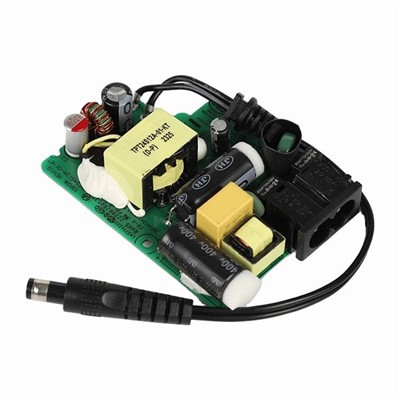

As a single rail power supply supplier, I've witnessed firsthand the critical role these power supplies play in various electronic systems. One of the most significant aspects that often goes under - the - radar but has a profound impact on system performance is the relationship between a single rail power supply and the overall system temperature.
Understanding Single Rail Power Supplies
Before delving into the impact on system temperature, let's briefly understand what single rail power supplies are. A single rail power supply provides a single output voltage level. For example, it could be a 5V, 12V, or 24V supply. They are widely used in many electronic devices due to their simplicity and cost - effectiveness. We offer a range of single rail power supplies, including the LED Driver Power Board, AC - DC Switching Power Supply, and 12V3A Bare Board.
Heat Generation in Single Rail Power Supplies
All power supplies generate heat as a by - product of their operation. In single rail power supplies, heat is mainly produced due to internal power losses. These losses occur in components such as transformers, rectifiers, and voltage regulators.
Transformer Losses
Transformers are essential components in power supplies. They are used to step up or step down the input voltage to the desired output voltage. However, transformers are not 100% efficient. Eddy current losses and hysteresis losses in the transformer core result in heat generation. Eddy currents are induced in the core material, and the energy dissipated as heat due to the resistance of the core. Hysteresis losses occur because the magnetic domains in the core material need to be realigned with each cycle of the alternating current.
Rectifier Losses
Rectifiers are used to convert alternating current (AC) to direct current (DC). During this conversion process, there are voltage drops across the rectifier diodes. These voltage drops result in power dissipation in the form of heat. For example, in a typical silicon diode, there is a voltage drop of about 0.7V. When a significant amount of current flows through the diode, the power dissipated as heat (P = VI) can be substantial.
Voltage Regulator Losses
Voltage regulators are responsible for maintaining a stable output voltage. They work by dissipating the excess power as heat. For instance, if the input voltage to a linear voltage regulator is much higher than the desired output voltage, the regulator will have to dissipate the difference in power. This power dissipation leads to an increase in the temperature of the voltage regulator and, consequently, the overall power supply.
Impact on the Overall System Temperature
The heat generated by a single rail power supply can have a significant impact on the overall system temperature.


Component Degradation
High temperatures can cause components in the system to degrade more quickly. For example, the lifespan of electrolytic capacitors is highly temperature - dependent. As the temperature increases, the electrolyte in the capacitor evaporates at a faster rate, reducing its capacitance and increasing its equivalent series resistance (ESR). This can lead to instability in the power supply output and, ultimately, system failure.
Semiconductor devices such as transistors and integrated circuits also suffer from performance degradation at high temperatures. The mobility of charge carriers in semiconductors decreases with increasing temperature, which can lead to slower switching speeds and higher power consumption.
Thermal Runaway
In some cases, the increase in temperature can lead to a phenomenon known as thermal runaway. If a component in the power supply or the system generates more heat as its temperature rises, and this heat is not dissipated effectively, the temperature will continue to increase. This can cause a chain reaction, where other components also start to generate more heat, leading to a rapid increase in the overall system temperature. Thermal runaway can cause catastrophic failure of the system.
Cooling Requirements
To maintain the system within a safe operating temperature range, additional cooling measures may be required. This can include the use of heat sinks, fans, or liquid cooling systems. However, these cooling solutions add to the cost, size, and complexity of the system. For example, a large heat sink may be required to dissipate the heat generated by a high - power single rail power supply. This not only takes up more space in the system but also adds to the weight.
Mitigating the Impact on System Temperature
As a supplier, we understand the importance of minimizing the impact of single rail power supplies on system temperature.
High - Efficiency Design
We focus on designing single rail power supplies with high efficiency. By reducing the internal power losses, we can minimize the amount of heat generated. For example, using high - quality transformers with low core losses and advanced rectifier technologies can significantly improve the efficiency of the power supply. Our AC - DC Switching Power Supply is designed with high - efficiency components to reduce heat generation.
Thermal Management
Proper thermal management is crucial. We incorporate heat sinks and thermal vias in our power supply designs to improve heat dissipation. Heat sinks increase the surface area available for heat transfer, allowing the heat to be dissipated more effectively into the surrounding environment. Thermal vias are used to transfer heat from the power - dissipating components on the printed circuit board (PCB) to the other side of the board, where it can be dissipated more easily.
System - Level Design Considerations
When integrating a single rail power supply into a system, proper system - level design is essential. This includes ensuring adequate ventilation in the system enclosure, placing the power supply in a location where it can dissipate heat effectively, and avoiding placing heat - sensitive components close to the power supply.
Conclusion
In conclusion, a single rail power supply can have a significant impact on the overall system temperature. The heat generated by the power supply due to internal losses can lead to component degradation, thermal runaway, and increased cooling requirements. However, by using high - efficiency designs, proper thermal management, and careful system - level design, we can minimize these impacts.
As a single rail power supply supplier, we are committed to providing high - quality power supplies that not only meet your power requirements but also help you manage system temperature effectively. If you are interested in our products or have any questions regarding single rail power supplies and their impact on system temperature, we invite you to contact us for procurement and further discussions.
References
- "Power Electronics: Converters, Applications, and Design" by Ned Mohan, Tore M. Undeland, and William P. Robbins.
- "Thermal Management of Electronic Systems" by Avram Bar - Cohen and Ali Borca - Tasic.
- "Semiconductor Device Physics" by Donald A. Neamen.