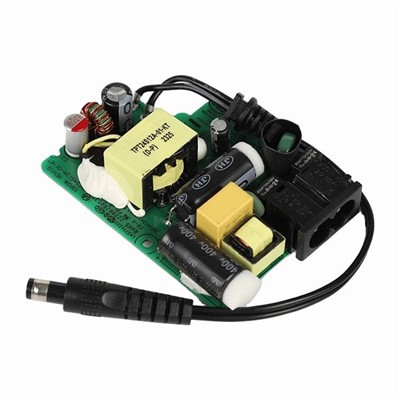

In the realm of electronics, dual rail power supplies play a crucial role in providing stable and balanced power to a wide range of applications. These power supplies offer both positive and negative voltage outputs, which are essential for circuits that require bipolar power, such as operational amplifiers, audio amplifiers, and certain types of sensors. However, achieving proper isolation in a dual rail power supply is often a challenging yet critical task. As a leading dual rail power supply supplier, we understand the intricacies involved in this process and are here to share some valuable insights on how to achieve effective isolation.
Understanding the Importance of Isolation in Dual Rail Power Supplies
Isolation in a dual rail power supply serves multiple purposes. Firstly, it helps to prevent electrical interference between different parts of a circuit. In a dual rail system, the positive and negative voltage rails can interact with each other and with other components in the circuit. Without proper isolation, this interaction can lead to noise, signal distortion, and even damage to sensitive components.
Secondly, isolation provides safety. It separates the power supply from the rest of the circuit, reducing the risk of electrical shock to users and protecting the equipment from short - circuits and other electrical faults. This is especially important in industrial and high - power applications where the consequences of electrical accidents can be severe.
Methods for Achieving Isolation
Transformer - Based Isolation
One of the most common methods for achieving isolation in a dual rail power supply is through the use of transformers. A transformer consists of a primary winding and one or more secondary windings. When an alternating current (AC) is applied to the primary winding, it creates a magnetic field that induces a voltage in the secondary windings.


In a dual rail power supply, a center - tapped transformer can be used. The center tap is typically connected to ground, and the two ends of the secondary winding provide the positive and negative voltage outputs. The physical separation between the primary and secondary windings of the transformer provides electrical isolation.
For example, in our Dual Channel Industrial Power Board, we utilize high - quality transformers to ensure excellent isolation. The design of the transformer is carefully optimized to minimize leakage inductance and capacitance, which can degrade the isolation performance.
Opto - Isolation
Opto - isolation is another effective technique for achieving isolation in a dual rail power supply. An opto - isolator, also known as an optocoupler, consists of an LED and a photodetector. The input signal is applied to the LED, which emits light. The photodetector then converts the light into an electrical signal on the output side.
Since there is no direct electrical connection between the input and output of an opto - isolator, it provides excellent isolation. Opto - isolators are often used to isolate control signals in a dual rail power supply. For instance, in a power supply that requires feedback control, an opto - isolator can be used to transmit the feedback signal from the output side to the control circuit on the input side without creating an electrical connection.
Our Server - Grade Power Supply Board incorporates opto - isolation technology in its control circuitry. This helps to ensure that the control signals are accurately transmitted while maintaining isolation between different parts of the power supply.
Isolated DC - DC Converters
Isolated DC - DC converters are also commonly used to achieve isolation in dual rail power supplies. These converters take an input DC voltage and convert it to an isolated output DC voltage. They typically use a transformer - based design, similar to the transformer - based isolation method described above.
Isolated DC - DC converters offer several advantages. They can provide a high degree of isolation, and they can also step up or step down the voltage as required. In addition, they are compact and can be easily integrated into a power supply circuit. Our 250W Dual Output Power Module uses high - efficiency isolated DC - DC converters to achieve isolation and provide stable dual rail outputs.
Design Considerations for Achieving Isolation
Component Selection
The selection of components is crucial for achieving good isolation in a dual rail power supply. When choosing transformers, opto - isolators, and isolated DC - DC converters, it is important to consider their isolation ratings. The isolation rating indicates the maximum voltage that can be applied between the isolated parts of the component without causing breakdown.
For example, in high - voltage applications, components with higher isolation ratings should be selected. In addition, the quality and reliability of the components also play a significant role. High - quality components are less likely to suffer from insulation breakdown and other failures over time.
Layout Design
The layout of the power supply circuit also affects the isolation performance. In the printed circuit board (PCB) design, it is important to keep the isolated parts of the circuit physically separated. This includes separating the primary and secondary sides of transformers, the input and output sides of opto - isolators, and the input and output terminals of isolated DC - DC converters.
Proper grounding is also essential. The ground planes on the PCB should be carefully designed to minimize ground loops, which can degrade the isolation performance. In addition, the use of guard traces and shielding can help to reduce electromagnetic interference and improve the isolation.
Testing and Verification
After the design and assembly of the dual rail power supply, it is necessary to conduct thorough testing and verification to ensure that the isolation requirements are met. This includes testing the isolation resistance, dielectric strength, and leakage current.
Isolation resistance testing measures the resistance between the isolated parts of the power supply. A high isolation resistance indicates good isolation. Dielectric strength testing involves applying a high voltage between the isolated parts for a specified period to check for insulation breakdown. Leakage current testing measures the small current that flows between the isolated parts under normal operating conditions.
Conclusion
Achieving isolation in a dual rail power supply is a complex but essential task. By using appropriate isolation methods such as transformer - based isolation, opto - isolation, and isolated DC - DC converters, and paying attention to component selection, layout design, and testing, we can ensure that the power supply provides reliable and safe operation.
As a trusted dual rail power supply supplier, we are committed to providing high - quality products that meet the strictest isolation requirements. Our Dual Channel Industrial Power Board, Server - Grade Power Supply Board, and 250W Dual Output Power Module are all designed and manufactured with the latest isolation technologies to provide excellent performance and reliability.
If you are in need of a dual rail power supply for your application, we invite you to contact us for procurement and further technical discussions. Our team of experts is ready to assist you in finding the best power supply solution for your specific requirements.
References
- Paul, Clayton R. "Electromagnetic Compatibility for Power Electronics: Principles, Design, and Applications." John Wiley & Sons, 2014.
- Pressman, Abraham I. "Switching Power Supply Design." McGraw - Hill, 2009.
- Mohan, Ned, Tore M. Undeland, and William P. Robbins. "Power Electronics: Converters, Applications, and Design." John Wiley & Sons, 2012.