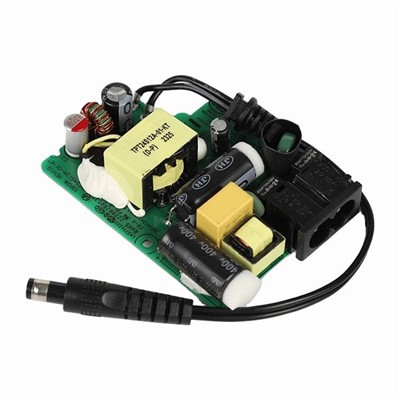

How to calculate the power requirements for a dual rail power supply?
As a supplier of dual rail power supplies, I often encounter customers who are unsure about how to calculate the power requirements for their specific applications. This blog post aims to provide a comprehensive guide on this topic, helping you make informed decisions when selecting the right dual rail power supply for your needs.
Understanding Dual Rail Power Supplies
Before diving into the calculations, it's essential to understand what a dual rail power supply is and how it works. A dual rail power supply provides two separate voltage outputs, typically one positive and one negative, relative to a common ground. This configuration is commonly used in applications that require both positive and negative voltages, such as audio amplifiers, operational amplifiers, and some types of electronic test equipment.
The two voltage rails are designed to operate independently, allowing for greater flexibility in powering different components or circuits within a system. For example, in an audio amplifier, the positive rail might power the output stage, while the negative rail provides the necessary bias for the input stage.
Factors Affecting Power Requirements
Several factors need to be considered when calculating the power requirements for a dual rail power supply. These include:
- Load Current: The current drawn by the connected devices or circuits is a crucial factor in determining the power requirements. Each load connected to the positive and negative rails will have its own current consumption, which must be added together to calculate the total current for each rail.
- Voltage Levels: The voltage levels required by the loads on each rail must be known. Dual rail power supplies typically offer a range of voltage options, such as ±5V, ±12V, or ±15V. The power consumption of a load is calculated by multiplying the voltage across the load by the current flowing through it (P = VI).
- Efficiency: The efficiency of the power supply itself affects the overall power requirements. A more efficient power supply will convert a higher percentage of the input power into usable output power, reducing the amount of power wasted as heat. When calculating the power requirements, it's important to account for the efficiency of the power supply to ensure that it can provide enough power to meet the load demands.
- Peak vs. Continuous Power: Some loads may require more power during startup or peak operating conditions than they do during normal, continuous operation. It's important to consider both the peak and continuous power requirements of the loads to ensure that the power supply can handle the maximum power demands without overheating or failing.
Calculating Power Requirements
To calculate the power requirements for a dual rail power supply, follow these steps:
- Determine the Load Current for Each Rail: Identify all the loads connected to the positive and negative rails and measure or estimate the current consumption of each load. Add up the current consumption of all the loads on each rail to calculate the total current for that rail.
- Calculate the Power Consumption for Each Rail: Multiply the total current for each rail by the voltage of that rail to calculate the power consumption for each rail. For example, if the total current on the positive rail is 2A and the voltage is +12V, the power consumption on the positive rail is P+ = 12V x 2A = 24W. Similarly, if the total current on the negative rail is 1A and the voltage is -12V, the power consumption on the negative rail is P- = -12V x 1A = -12W. Note that the negative sign indicates the direction of the current flow, but the power consumption is still a positive value.
- Account for Efficiency: Divide the total power consumption of each rail by the efficiency of the power supply to calculate the input power required for each rail. For example, if the power consumption on the positive rail is 24W and the efficiency of the power supply is 80%, the input power required for the positive rail is Pin+ = 24W / 0.8 = 30W. Similarly, if the power consumption on the negative rail is 12W and the efficiency is 80%, the input power required for the negative rail is Pin- = 12W / 0.8 = 15W.
- Consider Peak Power Requirements: If the loads have peak power requirements that are higher than their continuous power requirements, make sure to account for these peak demands when selecting the power supply. Choose a power supply that can provide enough power to handle the peak loads without overheating or failing.
Example Calculation
Let's consider an example to illustrate the calculation process. Suppose we have a system with the following loads connected to a dual rail power supply:
- Positive Rail: Two loads, each drawing 1A at +12V.
- Negative Rail: One load drawing 0.5A at -12V.
- Calculate the Load Current for Each Rail:
- Positive Rail: Total current = 1A + 1A = 2A
- Negative Rail: Total current = 0.5A
- Calculate the Power Consumption for Each Rail:
- Positive Rail: P+ = 12V x 2A = 24W
- Negative Rail: P- = -12V x 0.5A = -6W (power consumption is 6W)
- Account for Efficiency: Assume the power supply has an efficiency of 80%.
- Positive Rail: Pin+ = 24W / 0.8 = 30W
- Negative Rail: Pin- = 6W / 0.8 = 7.5W
- Total Power Requirements: The total power required from the power supply is the sum of the input power requirements for each rail, which is 30W + 7.5W = 37.5W.
Selecting the Right Dual Rail Power Supply
Once you have calculated the power requirements for your dual rail power supply, you can select a power supply that can meet or exceed these requirements. When choosing a power supply, consider the following factors:
- Power Rating: Make sure the power supply has a power rating that is sufficient to handle the total power requirements of your system, including any peak power demands.
- Voltage Outputs: Choose a power supply that offers the voltage levels required by your loads. Dual rail power supplies typically offer a range of voltage options, so select one that matches your specific needs.
- Efficiency: Look for a power supply with a high efficiency rating to minimize power losses and reduce operating costs.
- Reliability and Quality: Consider the reputation and reliability of the power supply manufacturer. Choose a power supply that is built to last and has a good track record of performance.
As a supplier of dual rail power supplies, we offer a wide range of products to meet your specific needs. Our Heavy-Duty Switching Power Module is designed for high-power applications, providing reliable and efficient power delivery. Our Server-Grade Power Supply Board is ideal for applications that require high reliability and performance, such as servers and data centers. And our 250W Dual Output Power Module offers a compact and efficient solution for a variety of dual rail power applications.
Conclusion
Calculating the power requirements for a dual rail power supply is an important step in selecting the right power supply for your application. By considering the load current, voltage levels, efficiency, and peak power requirements, you can ensure that the power supply can provide enough power to meet the demands of your system. If you have any questions or need assistance in calculating the power requirements or selecting the right dual rail power supply, please feel free to contact us. We are here to help you find the best solution for your needs.


References
- Horowitz, P., & Hill, W. (1989). The Art of Electronics. Cambridge University Press.
- Sedra, A. S., & Smith, K. C. (2015). Microelectronic Circuits. Oxford University Press.