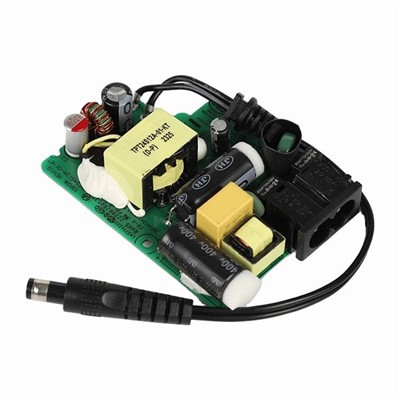

As a reliable supplier of AC adapters for PCs, I am well - versed in the components that make up these essential power devices. In this blog, I will delve into the key components of an AC adapter for PCs, explaining their functions and importance.
1. Input Plug
The input plug is the part of the AC adapter that connects to the electrical outlet. It is designed to fit the specific socket type used in different regions. For example, in North America, the standard plug has two flat prongs and sometimes a third grounding prong. In Europe, a variety of plug types are used, such as the two - prong Europlug. The input plug must be made of high - quality conductive materials, usually copper or brass, to ensure efficient transfer of electrical current from the outlet to the adapter. It also needs to have proper insulation to prevent electrical shocks. A well - designed input plug provides a stable connection to the power source, which is the first step in the power - conversion process.
2. Power Cord
The power cord is the cable that connects the input plug to the main body of the AC adapter. It is typically made of flexible, insulated wire. The wire gauge of the power cord is an important factor. A thicker wire (lower gauge number) can carry more current with less resistance, reducing the risk of overheating. The insulation on the power cord protects the wire from damage and prevents electrical short - circuits. It also needs to be durable enough to withstand bending, pulling, and other physical stresses during normal use. High - quality power cords are often made with materials like PVC (polyvinyl chloride) or rubber, which offer good insulation and flexibility.
3. Transformer
The transformer is one of the most crucial components of an AC adapter. Its main function is to change the high - voltage alternating current (AC) from the power outlet to a lower - voltage AC. Transformers work based on the principle of electromagnetic induction. They consist of two coils of wire, a primary coil and a secondary coil, wound around a magnetic core. The ratio of the number of turns in the primary and secondary coils determines the voltage transformation ratio. For example, if the primary coil has 100 turns and the secondary coil has 10 turns, the output voltage will be one - tenth of the input voltage. In a PC AC adapter, the transformer steps down the standard household voltage (e.g., 110V or 230V) to a lower voltage suitable for the PC, such as 12V or 24V.
4. Rectifier
After the voltage is stepped down by the transformer, the output is still an alternating current. However, most PCs require direct current (DC) to operate. The rectifier is responsible for converting the lower - voltage AC from the transformer into DC. A common type of rectifier used in AC adapters is the bridge rectifier, which is made up of four diodes. Diodes are semiconductor devices that allow current to flow in only one direction. The bridge rectifier arrangement ensures that the negative half - cycles of the AC input are inverted, resulting in a pulsating DC output.
5. Filter Capacitors
The pulsating DC output from the rectifier is not suitable for direct use in a PC because it contains ripples. Filter capacitors are used to smooth out these ripples and provide a more stable DC voltage. Capacitors store electrical charge and release it when the voltage drops, helping to maintain a relatively constant voltage level. They are connected in parallel with the DC output of the rectifier. Different values of capacitance are used depending on the power requirements of the adapter and the level of ripple suppression needed. Larger capacitors can store more charge and are generally better at reducing ripple, but they also take up more space and can be more expensive.
6. Voltage Regulator
Even after filtering, the DC voltage may still vary slightly due to changes in the input voltage or the load on the adapter. A voltage regulator is used to maintain a constant output voltage regardless of these variations. There are two main types of voltage regulators: linear regulators and switching regulators. Linear regulators are simple and inexpensive but are less efficient, especially when there is a large difference between the input and output voltages. Switching regulators, on the other hand, are more complex but much more efficient. They work by rapidly switching the input voltage on and off and then filtering the resulting pulses to obtain a regulated output voltage. Most modern PC AC adapters use switching regulators to improve energy efficiency and reduce heat generation.
7. Output Connector
The output connector is the part of the AC adapter that connects to the PC. It is designed to fit the specific power input port on the PC. Different types of output connectors are used, such as barrel connectors, USB - C connectors, etc. The output connector must provide a secure and reliable connection to ensure that the PC receives the correct amount of power. It also needs to be properly insulated to prevent short - circuits. For example, barrel connectors have a center pin and an outer sleeve, and the polarity of the connection must be correct for the PC to work properly.
8. Protection Circuits
AC adapters for PCs are equipped with various protection circuits to safeguard both the adapter and the connected PC. Over - voltage protection (OVP) circuits monitor the output voltage and cut off the power if the voltage exceeds a safe level. This protects the PC from damage due to excessive voltage. Over - current protection (OCP) circuits detect when the current flowing through the adapter exceeds a certain limit and shut down the power supply to prevent overheating and damage to the components. Short - circuit protection (SCP) circuits quickly detect and respond to short - circuits, which can occur if the output terminals of the adapter are accidentally connected together. Thermal protection circuits monitor the temperature of the adapter and reduce the power output or shut down the adapter if it gets too hot, preventing damage from overheating.
Our Product Offerings
We offer a wide range of AC adapters for PCs to meet different power requirements. For low - power applications, our 24w Power Adapter is a great choice. It is compact and energy - efficient, suitable for small desktop PCs or laptops with lower power consumption.
If you are a gamer or have a high - performance PC, our Gaming PC Adapter is designed to provide the stable and high - power output needed for smooth gaming and other intensive tasks.
For more demanding applications, we also have the 150w Power Adapter, which can handle the power requirements of powerful desktop computers with multiple components.
Contact Us for Procurement
If you are interested in our AC adapters for PCs, we invite you to contact us for procurement. Our team of experts can provide you with detailed product information, technical support, and competitive pricing. Whether you are a small business looking for a few adapters or a large enterprise in need of bulk orders, we are committed to meeting your needs.


References
- "Power Electronics: Converters, Applications, and Design" by Ned Mohan, Tore M. Undeland, and William P. Robbins.
- "The Art of Electronics" by Paul Horowitz and Winfield Hill.