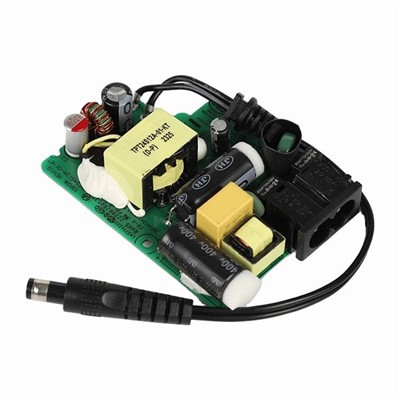

When it comes to series - connecting PCB mount power supplies, there are several crucial aspects that need to be taken into careful consideration. As a reliable supplier of PCB Mount Power Supply, I have witnessed firsthand the importance of these factors in ensuring the proper functioning and safety of the power supply system.
Electrical Compatibility
The first and foremost thing to note is the electrical compatibility of the power supplies being connected in series. All power supplies in the series connection must have the same current rating. If the current ratings are different, the power supply with the lower current rating will act as a bottleneck, potentially leading to overheating and premature failure. For example, if one PCB Mount Power Supply can handle a maximum current of 2A and another can handle 3A, when connected in series, the overall current capacity of the series - connected system will be limited to 2A.


Voltage compatibility is also essential. The sum of the output voltages of the series - connected power supplies should match the requirements of the load. However, it's important to ensure that the individual power supplies can handle the reverse voltage that may occur during operation. Some power supplies are designed with built - in protection against reverse voltage, but it's still a factor to double - check.
Thermal Management
Series - connecting power supplies can generate more heat compared to using a single power supply. Each power supply dissipates heat during normal operation, and when they are connected in series, the cumulative heat can become a significant issue. Adequate thermal management is crucial to prevent overheating, which can degrade the performance and lifespan of the power supplies.
Proper ventilation is necessary to dissipate the heat effectively. This can be achieved by ensuring that there is enough space around the power supplies for air to circulate. Additionally, heat sinks can be used to increase the surface area for heat dissipation. If the power supplies are installed in an enclosure, the enclosure should be designed with ventilation holes or fans to remove the hot air.
Protection Circuits
Power supplies are often equipped with various protection circuits such as over - current protection (OCP), over - voltage protection (OVP), and short - circuit protection (SCP). When connecting power supplies in series, it's important to ensure that these protection circuits work properly together.
For example, if one power supply has an over - current protection set at 2A and another at 3A, the overall over - current protection of the series - connected system needs to be carefully coordinated. In some cases, it may be necessary to use external protection circuits to ensure the safety of the entire system.
Load Balancing
Load balancing is another important consideration. When power supplies are connected in series, the load should be evenly distributed among them. Uneven load distribution can cause one power supply to bear more stress than the others, leading to premature failure.
To achieve load balancing, the impedance of the load should be carefully matched to the output impedance of the series - connected power supplies. In some cases, load - sharing circuits can be used to ensure that each power supply contributes an equal amount of power to the load.
Isolation
Isolation is a critical factor, especially in applications where electrical safety is a concern. Power supplies may have different levels of isolation between the input and output. When connecting power supplies in series, the isolation characteristics of the individual power supplies need to be considered.
For example, if the power supplies are used in a medical device, high - level isolation is required to prevent electrical shock to the patient. In such cases, it's important to ensure that the series - connected power supplies maintain the required isolation level.
Monitoring and Testing
Before and after series - connecting the power supplies, thorough monitoring and testing are necessary. During the testing phase, the output voltage, current, and power of the series - connected system should be measured to ensure that they meet the design requirements.
Monitoring the temperature of the power supplies during operation is also crucial. This can be done using temperature sensors. If the temperature exceeds the recommended operating range, appropriate measures such as improving ventilation or reducing the load should be taken.
Case Study: Using 12V3A Bare Board in Series
Let's consider a scenario where we are using 12V3A Bare Board power supplies in series. Suppose we need a 24V power supply for a specific load, and we decide to connect two 12V3A Bare Board power supplies in series.
First, we need to ensure that the current ratings of the two power supplies are the same. Since both are 3A, the overall current capacity of the series - connected system will be 3A, and the output voltage will be 24V (12V + 12V).
We also need to pay attention to thermal management. These bare - board power supplies will generate heat during operation, so we need to provide proper ventilation and, if necessary, use heat sinks.
The protection circuits of the two power supplies should be checked to ensure that they work together. If there is an over - current situation, the over - current protection of both power supplies should trigger to protect the system.
Conclusion
Series - connecting PCB Mount Power Supply can be a viable solution for applications that require higher voltages. However, it requires careful consideration of electrical compatibility, thermal management, protection circuits, load balancing, isolation, and monitoring.
As a supplier of high - quality PCB Mount Power Supply, we are committed to providing our customers with the best products and technical support. If you are considering series - connecting power supplies for your project, we encourage you to contact us for further discussion and procurement. Our team of experts can help you select the right power supplies and ensure that they are connected safely and effectively.
References
- "Power Supply Design Handbook" by Marty Brown
- "Electrical Engineering Handbook" edited by Richard C. Dorf
If you are interested in purchasing our PCB Mount Power Supply or need more information about series - connecting power supplies, please feel free to reach out to us for procurement discussions. We look forward to serving you.