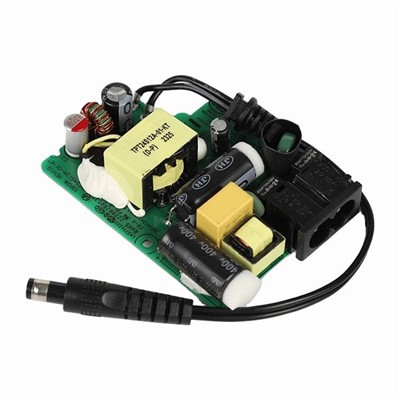

Hey there! As a supplier of dual rail power supplies, I've seen firsthand how crucial line regulation is for these power sources. Line regulation refers to the ability of a power supply to maintain a stable output voltage despite fluctuations in the input voltage. In a dual rail power supply, which provides both positive and negative voltages, good line regulation ensures that both rails stay stable, which is super important for the proper functioning of the equipment they power. So, let's dive into how we can enhance the line regulation of a dual rail power supply.
Understanding the Basics
Before we start talking about how to improve line regulation, it's important to understand what affects it. The line regulation of a power supply is mainly influenced by two things: the internal resistance of the power supply and the load current. When the input voltage changes, the internal resistance causes a voltage drop, which can lead to a change in the output voltage. The load current also plays a role because as the load changes, the power supply has to adjust to keep the output voltage stable.
Choose the Right Components
One of the first steps in enhancing line regulation is to choose the right components for your dual rail power supply. High - quality resistors, capacitors, and inductors are essential. For example, low - ESR (Equivalent Series Resistance) capacitors can help reduce voltage ripple and improve the transient response of the power supply. When it comes to inductors, ones with high saturation current ratings can handle larger load currents without saturating, which helps maintain a stable output voltage.
We offer a range of great power modules, like the 250W Dual Output Power Module. This module is designed with high - quality components that are carefully selected to provide excellent line regulation. It's a great choice for applications that require stable dual rail power.
Implement Feedback Loops
Feedback loops are a key part of any power supply design. In a dual rail power supply, you can use both voltage feedback and current feedback. Voltage feedback compares the actual output voltage with a reference voltage and adjusts the power supply's output to keep them in line. Current feedback, on the other hand, monitors the load current and helps the power supply respond to changes in the load more quickly.
By using a well - designed feedback loop, you can significantly improve the line regulation of your dual rail power supply. For instance, a proportional - integral - derivative (PID) controller in the feedback loop can adjust the output voltage based on the error between the actual and desired values. This helps the power supply quickly compensate for any input voltage changes.
Use Voltage Regulation Techniques
There are several voltage regulation techniques that can be employed to enhance line regulation. One common method is linear regulation. Linear regulators use a pass transistor to adjust the output voltage. They are simple and can provide very low noise output, but they are not very efficient, especially when there is a large difference between the input and output voltages.
Another technique is switching regulation. Switching regulators are more efficient than linear regulators because they use a switching element (like a MOSFET) to control the power flow. They can handle larger input - output voltage differences and are suitable for high - power applications. Our Heavy - Duty Switching Power Module uses advanced switching regulation techniques to provide excellent line regulation even under heavy loads.
Thermal Management
Heat can have a big impact on the performance of a power supply, including its line regulation. When components get too hot, their electrical characteristics can change, which can lead to a decrease in line regulation. So, proper thermal management is crucial.
You can use heat sinks, fans, or other cooling methods to keep the temperature of the power supply within an acceptable range. For example, a well - designed heat sink can dissipate heat from the power supply's components, preventing them from overheating. This helps maintain the stability of the components and, in turn, improves the line regulation of the dual rail power supply.
Isolation and Filtering
Isolation between the input and output of the power supply can also improve line regulation. Isolation transformers can be used to separate the input and output circuits, reducing the influence of input voltage fluctuations on the output. Additionally, input and output filters can help remove noise and interference from the power supply.


Filters can be made up of capacitors and inductors and are designed to block unwanted frequencies. For example, a low - pass filter can be used to remove high - frequency noise from the input voltage, which can improve the overall performance of the power supply and its line regulation. Our Telecom PSU uses advanced isolation and filtering techniques to ensure stable dual rail power output.
Testing and Calibration
Once you've built or selected a dual rail power supply, it's important to test and calibrate it. Testing can help you identify any issues with the line regulation and make adjustments as needed. You can use test equipment like oscilloscopes and multimeters to measure the input and output voltages and check for any fluctuations.
Calibration involves adjusting the power supply's settings to ensure that the output voltage is within the desired tolerance. This can be done by adjusting the feedback loop or other control parameters. Regular testing and calibration can help maintain the line regulation of the power supply over time.
Conclusion
Enhancing the line regulation of a dual rail power supply is a multi - step process that involves choosing the right components, implementing feedback loops, using proper voltage regulation techniques, managing heat, and ensuring isolation and filtering. By following these steps, you can ensure that your dual rail power supply provides a stable output voltage, even when the input voltage fluctuates.
If you're in the market for a high - quality dual rail power supply with excellent line regulation, we've got you covered. Our range of power modules, including the 250W Dual Output Power Module, Heavy - Duty Switching Power Module, and Telecom PSU, are designed to meet your needs. Contact us to discuss your requirements and start the procurement process. We're here to help you find the perfect power supply solution for your application.
References
- Horowitz, P., & Hill, W. (1989). The Art of Electronics. Cambridge University Press.
- Pressman, A. I. (2009). Switching Power Supply Design. McGraw - Hill.