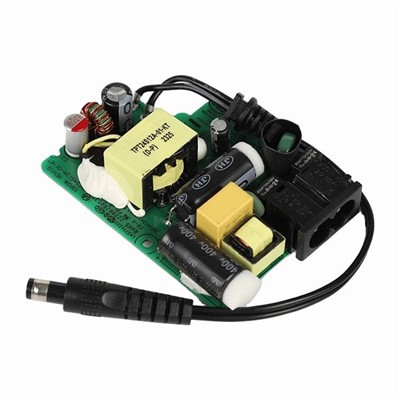

A dual rail power supply is a crucial component in many electronic systems, providing multiple voltage outputs with opposite polarities. As a leading supplier of dual rail power supplies, we understand the importance of these components and their role in various applications. In this blog post, we will explore the key components that make up a dual rail power supply and discuss their functions and significance.
Transformer
The transformer is the heart of a dual rail power supply. It plays a vital role in converting the input voltage from the mains supply to the desired output voltages. In a dual rail power supply, the transformer typically has a center - tapped secondary winding. This center - tapped design allows for the generation of two output voltages with opposite polarities relative to the center tap.
For example, if the center tap is grounded, one end of the secondary winding can provide a positive voltage, while the other end provides a negative voltage. The turns ratio of the transformer determines the magnitude of the output voltages. A well - designed transformer ensures efficient power transfer and isolation between the input and output circuits, which is essential for safety and performance.
Rectifier
After the transformer steps down or steps up the voltage, the rectifier comes into play. The rectifier is responsible for converting the alternating current (AC) output from the transformer into direct current (DC). In a dual rail power supply, two sets of rectifiers are usually used, one for the positive voltage rail and one for the negative voltage rail.
Common types of rectifiers include half - wave rectifiers, full - wave rectifiers, and bridge rectifiers. Bridge rectifiers are often preferred in dual rail power supplies due to their higher efficiency and better utilization of the AC input. They can convert both the positive and negative halves of the AC waveform into DC, resulting in a smoother output voltage.
Filter Capacitors
Filter capacitors are used to smooth out the pulsating DC output from the rectifier. When the rectifier converts AC to DC, the output still contains some ripple, which is an unwanted AC component. Filter capacitors store electrical energy during the peaks of the rectified voltage and release it during the troughs, reducing the ripple and providing a more stable DC voltage.


In a dual rail power supply, separate filter capacitors are used for the positive and negative voltage rails. The value of the filter capacitors is carefully selected based on the load requirements and the desired level of ripple reduction. Larger capacitors generally provide better ripple filtering but may also increase the size and cost of the power supply.
Voltage Regulators
Voltage regulators are essential components in a dual rail power supply as they ensure that the output voltages remain stable under varying load conditions. They maintain a constant output voltage even when the input voltage fluctuates or the load current changes.
There are two main types of voltage regulators: linear regulators and switching regulators. Linear regulators are simple and provide low - noise output, but they are less efficient, especially when there is a large difference between the input and output voltages. Switching regulators, on the other hand, are more efficient as they operate by rapidly switching the input voltage on and off. They are suitable for high - power applications but may generate more electromagnetic interference (EMI).
In a dual rail power supply, separate voltage regulators are used for the positive and negative voltage rails to ensure independent control and regulation of each output.
Feedback Circuit
The feedback circuit is a critical part of the voltage regulation system in a dual rail power supply. It continuously monitors the output voltages and compares them to a reference voltage. If the output voltage deviates from the desired value, the feedback circuit sends a signal to the voltage regulator to adjust the output voltage accordingly.
The feedback circuit typically consists of resistors, operational amplifiers, and other components. It provides a closed - loop control system that ensures the stability and accuracy of the output voltages.
Protection Circuits
To ensure the reliability and safety of the dual rail power supply, various protection circuits are incorporated. These include over - voltage protection (OVP), under - voltage protection (UVP), over - current protection (OCP), and short - circuit protection (SCP).
Over - voltage protection circuits detect when the output voltage exceeds a certain threshold and take appropriate action to prevent damage to the connected devices. Under - voltage protection circuits monitor the input or output voltage and shut down the power supply if the voltage drops below a safe level. Over - current protection circuits limit the current flowing through the power supply to prevent overheating and component failure. Short - circuit protection circuits quickly detect a short - circuit condition and disconnect the power supply to avoid damage.
Applications of Dual Rail Power Supplies
Dual rail power supplies are widely used in many applications, including audio amplifiers, analog circuits, and test equipment. In audio amplifiers, the positive and negative voltage rails are used to power the amplifier stages, allowing for the amplification of both positive and negative halves of the audio signal. This results in a more accurate and faithful reproduction of the audio waveform.
In analog circuits, dual rail power supplies are essential for providing the necessary voltage levels for proper operation. They are used in operational amplifiers, comparators, and other analog components to ensure accurate signal processing.
Test equipment, such as oscilloscopes and function generators, also rely on dual rail power supplies to provide stable and accurate voltage outputs for testing and measurement purposes.
Our Product Offerings
As a dual rail power supply supplier, we offer a wide range of products to meet the diverse needs of our customers. Our product portfolio includes Telecom PSU, which is designed for telecommunications applications, providing reliable power for communication equipment.
We also have Heavy - Duty Switching Power Module that can handle high - power loads with high efficiency. These modules are suitable for industrial applications where robustness and reliability are crucial.
In addition, our Dual Channel Industrial Power Board is specifically designed for industrial control systems, offering stable and accurate dual rail power outputs.
Conclusion
A dual rail power supply is a complex system composed of several key components, each playing a vital role in providing stable and reliable power. From the transformer that converts the input voltage to the protection circuits that safeguard the system, every component is carefully designed and integrated to ensure optimal performance.
If you are in need of a high - quality dual rail power supply for your application, we invite you to contact us for procurement and further discussion. Our team of experts is ready to assist you in selecting the right power supply solution for your specific requirements.
References
- Horowitz, P., & Hill, W. (1989). The Art of Electronics. Cambridge University Press.
- Scherz, P., & Monk, S. (2006). Practical Electronics for Inventors. McGraw - Hill.